What do potatoes, breakfast
cereals, pretzels, rice, corn, bread, bread products,
and more have in common? They are all popular dietary
picks that contain starch. While starch is important
for the diet, not all starches are the same. Starch
is part of the carbohydrate family (sugar, fiber,
starch) that is best known for maintaining the
body’s proper energy level. However,
commonly-consumed starches have a down-side, for once
in the body, they convert to sugar and raise blood
sugar levels. Too much sugar overloads the pancreas
so that it cannot produce enough insulin to offset
the sugar imbalance. This impasse puts the body at
risk for numerous health problems, particularly
diabetes, heart disease, cancer, and weight gain. It
is thus important to learn the role of starches in
the diet and understand that not all starches are
healthy.
STARCH: the
Standard American Diet way
The Standard American Diet of cooked, processed,
animal-based foods offers products that have been
'refined' through various methods. These processes
alter the natural integrity of food which compromises
and ultimately destroys its nutritional value.
Stripping or altering food of its natural value turns
otherwise healthy food into unhealthy commodities.
Most popular and therefore commonly-consumed
starch-rich foods include
- potatoes
- breakfast cereals
- pretzels
- flours- white
flour, millet, sorghum, whole wheat flour
- oats
- Instant noodles
- breads, bread
products- bagels, english muffins, white
bread, tortillas, etc.
- cookies
- rice
- pasta
- corn, cornmeal
Most effected by refining
processes are whole grains such as white flour and
white flour products which turn into 'bad starches'
known as 'bad carbohydrates.' So it is that the
average American unwittingly becomes a carboholic,
being hooked on eating undigestible, unassimilable
and therefore toxic starches.
ENTER:
Resistant Starch
By definition resistant starch is also part of the
carbohydrate family but differs in that it resists
digestion in the small intestine and ferments in the
large intestine. This action is an important feature
for as the fibers in the food ferment they act as a
prebiotic and feed the good bacteria in the gut.
Thus, the digestive process is properly supported
because the body’s ability to digest and
assimilate food is dependent upon a proper balance of
good and bad bacteria in the gut.
RESISTANT
STARCH: Benefits
As starches are digested they break down into sugar
(glucose), high levels of which pose potential health
risks in the body. However, because resistant startch
is not digested in the small intestine, it does not
raise the body's glucose level. Instead, gut health
is improved as fermentation in the large intestine
makes more good bacteria and less bad bacteria in the
gut. Healthy gut bacteria can significantly improve
control of the body's glucose level. Additionally
resistant starchincreases the feeling of fullness,
aids in the treatment and prevention of constipation,
decreases bad cholesterol, and lowers the risk of
colon cancer. Furthermore, since resistant starch is
fermented slowly, it has the ability to cause less
gas.
RESISTANT
STARCH: Food Sources
Some foods that contain resistant starch include:
- Plantains and green
bananas (as a banana ripens the starch
changes to a regular starch
- Beans, peas, chickpeas,
lentils (white beans and lentils are the
highest in resistant starch
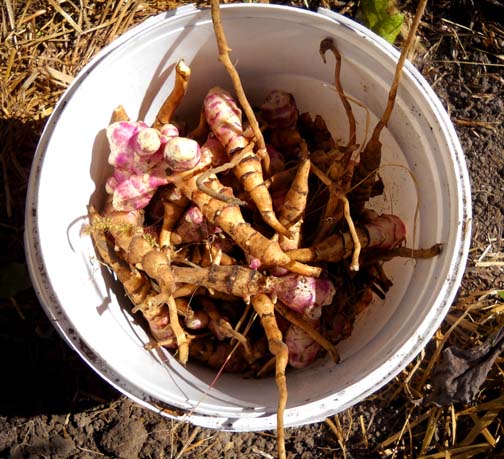
- Jerusalem Artichokes
(photo shown above)
- Whole grains including
oats and barley
- Cooked and cooled rice,
potatoes
The amount of resistant starch
changes with heat. Oats, green bananas, and plantains
lose some of their resistant starch when cooked.
Another type of resistant starch is made in the
cooking and cooling process. Cooked rice that has
been cooled is higher in resistant starch than rice
that was cooked and not cooled.
RESISTANT
STARCH: Adding to Your Diet
Since the full benefit of resistant starch found
in certain foods is lost when heated, consider the
following strategies.
- Cook rice, potatoes,
beans, and pasta a day in advance and cool in
the refrigerator overnight. If desired.
before eating as it does not decrease the
amount of resistant starch
- In place of cooked
oatmeal, eat uncooked oats soaked in filtered
water or a non-dairy milk and refrigerate
overnight (often called overnight oats).
- Add lentils to a salad
or soup.
- Replace white flour by
using flours made from resistant starch such
as green banana, plantain, cassava, Jerusalem
Artichoke, potato starch
Some resistant starch-filled
foods can be powdered and sprinkled on salads or used
raw as conventional flour substitutes. Furthermore,
for the sake of better gut health, choose to eat
low-starch vegetables such as
- Bell peppers
- Cauliflower, kale,
broccoli, kohlrabi
- Cucumbers
- Leafy greens, spinach,
Swiss chard
CONCLUSION
Digestion is the most important system of the body
for it is its food processing center and as such it
is responsible for feeding the body’s
100+trillion cells. If any part of this system fails,
the body risks potential harm. Therefore, care and
management of this system should elicit personal
commitment and priority.
Thankfully there is a growing
awareness of the body’s inner eco system, albeit
its ‘microbiome.’ While it is not necessary
to become a scientist in order to be healthy,
learning what constitutes good gut health and
applying those principles does bring lasting
benefits.
Recommended
resources:
John Kohler from okraw.com on resistant starch https://www.youtube.com/watch?v=AbyAdedx2Iw
Dr. Berg: #1 Most Dangerous
Carbohydrate in the World
https://www.youtube.com/shorts/VQyj-aFpk3o
Jerusalem Artichokes: Plant
once, harvest forever
https://www.youtube.com/watch?v=YROVfKt4xb4
Back to Living Letter #157 / index